Nusach Hat'filla -- What is it, and why is it important?
Nusach is Hebrew for formula. T’filla is Hebrew for prayer.
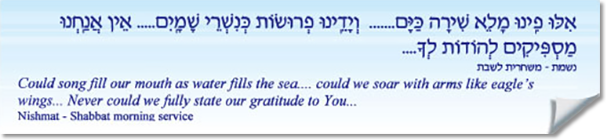
Jewish prayer text is carried on the wings of its musical expression. This is Nusach Hat’filla.
The term Nusach Hat’filla can apply to the liturgical text itself and refers to different textual rites according to variations of place and tradition.
When we refer to Nusach Hat’filla we also refer to the musical chants of those rites. Why is this musical formula so important? T’filla has always been chanted, from its roots in Middle-Eastern musical modes called maqamat, stemming from early times well before Western music was notated. The chants were like a time-and-place marker. In each of these traditions, all prayer services had their own specific modes of music which applied to the time of day, the time of the week, the time of the year. These chants created the mood of the service and were also special to the place where they were chanted. Different traditions developed, handed down from generation to generation and from community to community. These traditions prevail today.
Vital to human expression, music is a language in itself. As such, it has such an essential part to play in the life of the human soul. Therefore, we have a responsibility to transmit these traditions as faithfully as we can – and with love – so our people are enabled to enter their own devotion knowing they are linking back to generations before.
It is a holy responsibility and that is why EAJL stresses its importance, teaching and inspiring leaders of t’filla to be those who commit themselves to this sacred task with dedication and then pass it on.